
Where YOU get REAL Support and REAL Solutions
Defining Success Together
Autism and marriage aren't easy. We're here because we really get it.
REAL Neurodiverse Marriage
About Anne MacMillan
I built my original Neurodiverse Family Systems Theory on my education, personal life experience, and the professional experience I gained in the private neurodiverse services practice I founded in 2017.
Today, my services extend to support other professionals who have come to the new realization that neurodiversity is at the heart of many of the relationship challenges their adult clients face. Professionals can earn my Neurodiverse Family Systems Educator Credential (NFS-E) then use my practical 10-Step educational system, including quantitative assessments and support resources, to help their clients comprehend their relationship challenges and find the happiness and peace they deserve.
I have a research-based master's in psychology from Harvard University and studied developmental psychology as an undergrad. I received the Director's Thesis Award at Harvard for my original research on Level 1 autism and intimate life partnerships -- some of the first quantitative research on the subject in the world.
Altogether, I have over 50 years of personal life experience with neurodiverse family systems, over 20 years of personal life experience with neurodiverse intimate life partnerships, and 8 years of professional experience working with individuals managing the challenges of neurodiverse family systems.
I self-identify as a high body empathetic neurodivergent who just might also be a bit attention neurodivergent (ADHD). I am not autistic.

Anne MacMillan, MLA
Founder of the 10-Step Neurodiverse Family Systems Approach, Speaker, Researcher, Consultant, Coach, Educator and Expert Witness
Online Course Available Now
Married to Autism? Your Journey to Connection and Ease
An Online Course for Neurotypicals
and Non-Autistic Neurodivergents
Only $34.99 USD
Get the benefits of my education and life experience for less than the cost of one restaurant meal for two!
Neurodiverse relationships can be very confusing. Comprehending YOURSELF and the ways autism affects YOU can make all the difference. Take this first step towards
making life changes that will bring YOU the
Connection and Ease that YOU deserve.
Vicki R.

Found her insights spot on. I gifted this course to 2 others before I even finished it. Refreshing thoughts. Focus is on you, the NT of the relationship with great ways to look at things from both sides. Been married to Autism for 45 years and found this course something I will review on a regular basis to support myself.

Katie G.
This is a MUST for anyone who has a partner with autism. No matter where you are in your relationship, even if your relationship has ended, this is for YOU! Anne’s knowledge, compassion, guidance is unparalleled and unprecedented. Thank you Anne.
My Services
I offer consulting and coaching services to support you in achieving what you want from your life and for your partner, family and children. I work with either the autistic or the neurotypical partner.

Anne MacMillan, MLA
Founder of the R.E.A.L. 10-Step Neurodiverse Family Systems Approach, Speaker, Researcher, Educator, Consultant, Coach and Expert Witness
My Newest Blog Posts
Neurodiverse Relationship Dynamics™: A Three-Domain Framework
Neurodiverse Relationship Dynamics™: A Three-Domain Framework
Neurodiverse Relationship Dynamics™ (NRD™) describe the patterns that emerge when people with different neurologies—most often autistic and non-autistic—attempt to build and sustain relationships together. These dynamics are not caused by lack of effort, care, or commitment. They arise from fundamental differences in how different brains perceive, interpret, and navigate the social world.
NRD™ begins with perception. Autistic and non-autistic individuals take in social information differently, prioritize different cues, and rely on different internal processes to make sense of interactions. These differences shape how people understand one another’s intentions, how they experience closeness and distance, and how they respond to uncertainty or stress in relationships. Long before conflict appears, these neurological differences are already influencing how safety, trust, and meaning are constructed.
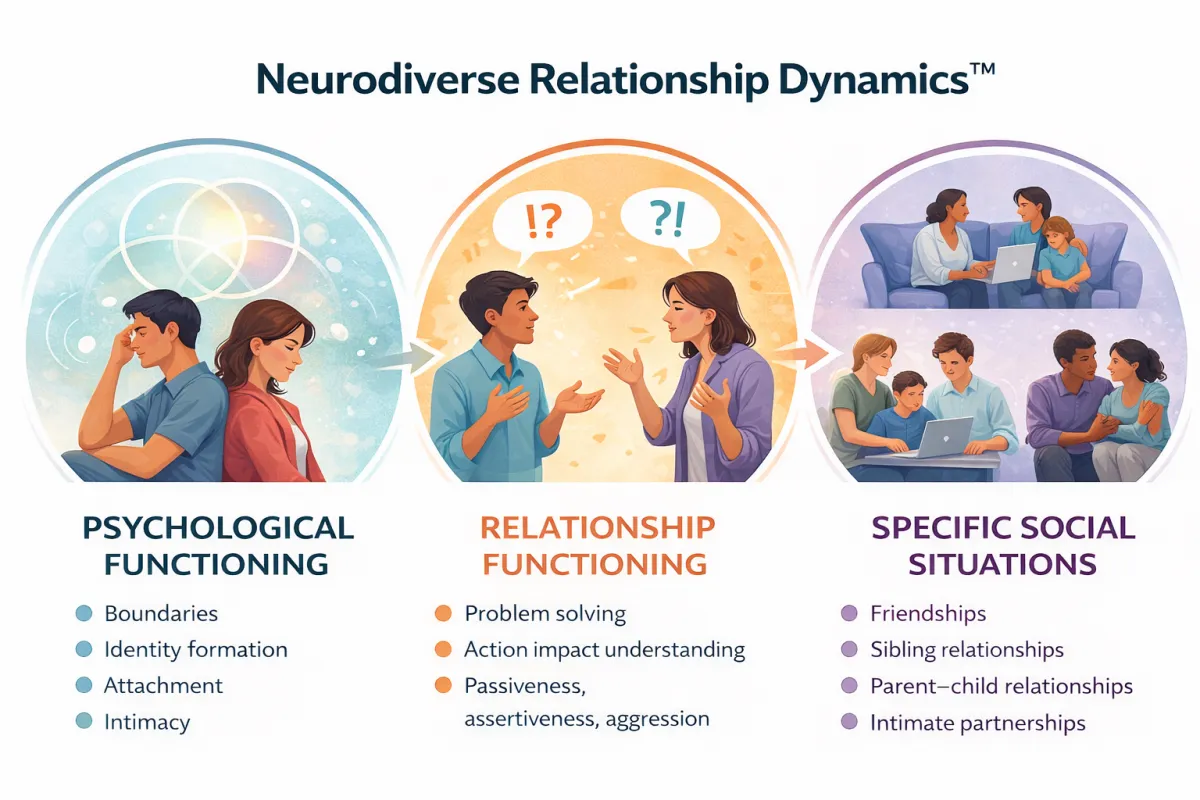
To fully understand NRD™, it is helpful to think in terms of three interconnected domains. Each domain represents a different layer of functioning that contributes to relational experience over time.
Psychological Functioning
The first domain concerns how individuals experience themselves within relationships. In neurodiverse systems, psychological functioning is often shaped by ongoing misattunement—subtle differences in perception that accumulate across years of interaction. This domain includes:
Attachment — how safety and trust are formed and maintained
Boundaries — how limits are sensed, communicated, and respected
Identity formation — how people come to define who they are in relation to others
Intimacy — how closeness is experienced, desired, or avoided
These processes develop internally, but they are deeply influenced by relational context. Over time, people may adapt by suppressing needs, blurring boundaries, or distancing from parts of themselves in order to preserve connection. When psychological functioning is not recognized as part of NRD™, these adaptations are often mistaken for personality traits rather than survival strategies.
Relationship Functioning
The second domain focuses on how people coordinate with one another once they are in relationship. This is where NRD™ often becomes most visible, especially when strain increases. Relationship functioning includes:
Problem solving — how differences are addressed and resolved
Action impact understanding — how clearly and to what extent each person perceives the effects of their actions on others
Passiveness, assertiveness, and aggression — how needs and boundaries are expressed under pressure
These patterns do not exist in isolation. They are shaped by psychological functioning and by the degree of safety present in the relationship. What may appear as avoidance, rigidity, or escalation is often an adaptive response to chronic misalignment rather than a deliberate relational stance.
Specific Social Situations
The third domain recognizes that neurodiverse dynamics change depending on context. The same neurological differences can produce very different experiences depending on the type of relationship involved. NRD™ plays out differently in:
Friendships, where expectations are flexible but repair is limited
Sibling relationships, where early roles and long histories persist
Parent–child relationships, where authority and dependency shape interaction
Intimate life partnerships, where attachment, intimacy, and daily coordination converge
As relational intensity and dependency increase, so does the complexity of NRD™. A pattern that feels manageable in a friendship may become exhausting or destabilizing in parenting or intimate partnership.
Holding the Whole System
These three domains—psychological functioning, relationship functioning, and specific social situations—are always interacting. NRD™ is not about fixing one behavior or improving one skill. It is about understanding how neurological differences shape entire relational systems over time.
When NRD™ is understood in this way, people are less likely to blame themselves or one another for patterns that were never individually chosen. Instead, they gain a clearer view of the invisible forces shaping their relationships—and the insight needed to make informed, self-respecting choices about how to move forward.

My Research
Some of the world's first quantitative research on autism and marriage
I was working on a master's in psychology at Harvard University when I realized my husband of almost 20 years was autistic. I was shocked by how little was known about an issue that affected my own life so dramatically. So, I shifted my research interests to autism and marriage and was ultimately given the Director's Thesis Award for my work.
My White Papers and Pamphlets
© 2024 R.E.A.L. Neurodiverse
All Rights Reserved
anne@REALneurodiverse.com
Text or Call: (617) 996-7239 (United States)